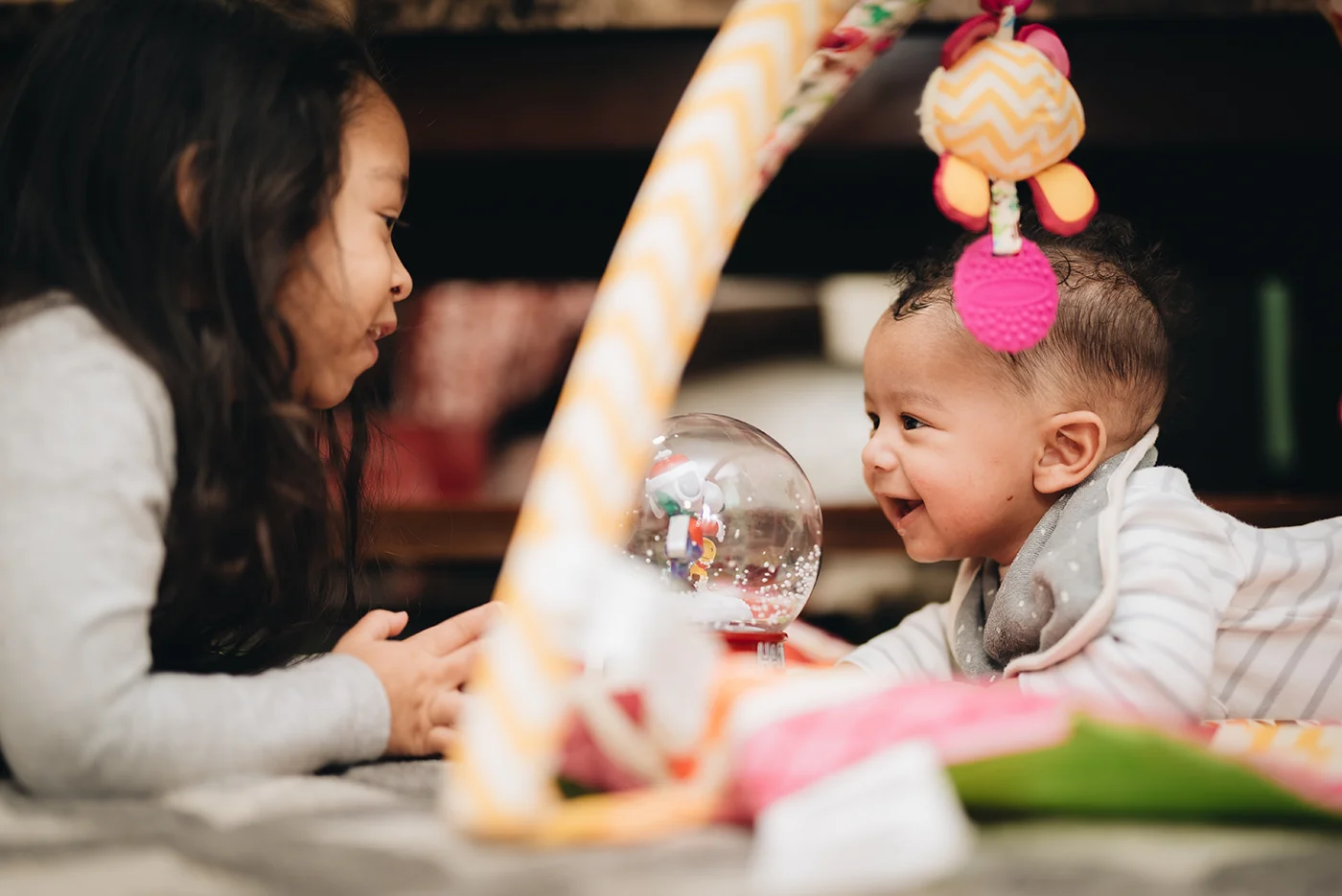
Communication is essential for allowing your child to express what they need and want but is also the basis for future skills like reading and spelling.
Early Communication Tips
- Encourage your baby to make vowel-like and consonant-vowel sounds such as “ma,” “da,” and “ba.” These sounds will encourage single words later on.
- Imitate your baby’s laughter and facial expressions. This lets your child know that you recognize their intent to interact with you.
- Teach your baby to imitate your actions, including clapping your hands, throwing kisses, and playing finger games such as pat-acake, peek-a-boo, and the itsy-bitsy-spider.
- Talk as you bathe, feed, and dress your baby. Talk about what you are doing, where you are going, what you will do when you arrive, and who and what you will see.
- Use gestures such as waving goodbye to help convey meaning. Gestures or simple signs will provide your child with a way to get what they want while they are learning words.
- Introduce animal sounds to associate a sound with a specific meaning: “The pig says oink-oink.”
- Expand on single words your baby uses. When your child says “ball,” add a descriptive word for example you can say “red ball” or “big ball.”
- Use good speech that is clear and simple for your child to model. Using too much “baby talk” can distort words. Children will learn better by hearing the adult form of a word.
- Expand vocabulary. Name body parts, and identify what you do with them. “This is my nose. I can smell flowers, popcorn, and soap.”
- Sing simple songs and recite nursery rhymes to show the rhythm and pattern of speech. Children enjoy repetitive sound patterns.